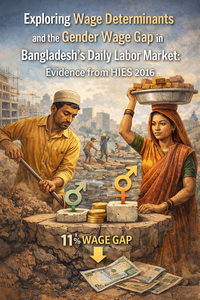
Exploring Wage Determinants and the Gender Wage Gap in Bangladesh’s Daily Labor Market: Evidence from HIES 2016
- By Al Mamun
- Wage determinants; gender wage gap; daily labor market; quantile regression; income inequality; labor economics
Project Description:
This project investigates how wages are determined and why gender-based wage disparities persist in Bangladesh’s daily labor market. Using nationally representative data from the 2016 Household Income and Expenditure Survey (HIES), the study examines how factors such as education, age, work experience, household characteristics, and gender influence workers’ earnings. It applies advanced econometric methods, including Ordinary Least Squares (OLS) and Quantile Regression, to explore wage differences across different income levels rather than focusing only on average wages. The findings provide evidence of substantial gender wage inequality, particularly among lower-paid workers, and identify the key factors contributing to these disparities. Based on the results, the study offers policy recommendations to promote equal pay, strengthen labor market opportunities for women, support workers in the informal sector, and reduce wage inequality. The project contributes to a better understanding of labor market dynamics and provides evidence to support more inclusive and equitable employment policies in Bangladesh.
Engagement:
Working Paper:
https://cperbd.org/working-paper/5
http://dx.doi.org/10.2139/ssrn.5547821
Research Article:
Title: An Analysis of Wage Determinants and Gender Wage Inequality in the Daily Labor Market of Bangladesh: A Quantile Regression Approach