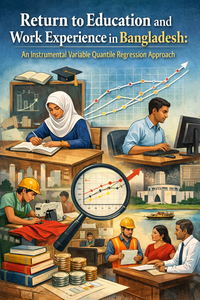
Return to Education and Work Experience in Bangladesh: An Instrumental Variable Quantile Regression Approach
- By Al Mamun; Md. Arfanuzzaman; Nusrat Jahan Nishat; Muhammad Enamul Haque; Navila Khan
- Returns to education; work experience; wage distribution; econometrics (IVQR); gender & rural–urban wage disparities; policy implications
Project Description:
This project examines how education and work experience influence workers’ earnings in Bangladesh and how these benefits differ across income groups. Using nationally representative data from the Household Income and Expenditure Survey (HIES) 2016–2017, the study explores the returns to human capital while accounting for wage differences by gender, location, and income level. It applies advanced econometric methods to estimate the true impact of education and work experience on earnings and to address potential bias in conventional wage models.
The research investigates whether the benefits of education are shared equally among workers or whether they vary across the wage distribution. It also examines how work experience contributes to earnings over time and assesses persistent wage inequalities between men and women, as well as between rural and urban workers. By using innovative analytical techniques, the study provides more reliable evidence on the role of human capital in shaping wage outcomes in Bangladesh.
The findings offer valuable insights for policies aimed at improving education, reducing wage inequality, promoting gender equity, and strengthening labor market opportunities. The project supports evidence-based policymaking by highlighting how investments in education and skills can contribute to higher earnings, greater productivity, and more inclusive economic growth. It also demonstrates CPER’s commitment to producing rigorous, policy-oriented research that addresses key labor market and human capital challenges in Bangladesh.
Engagement:
Working Paper: